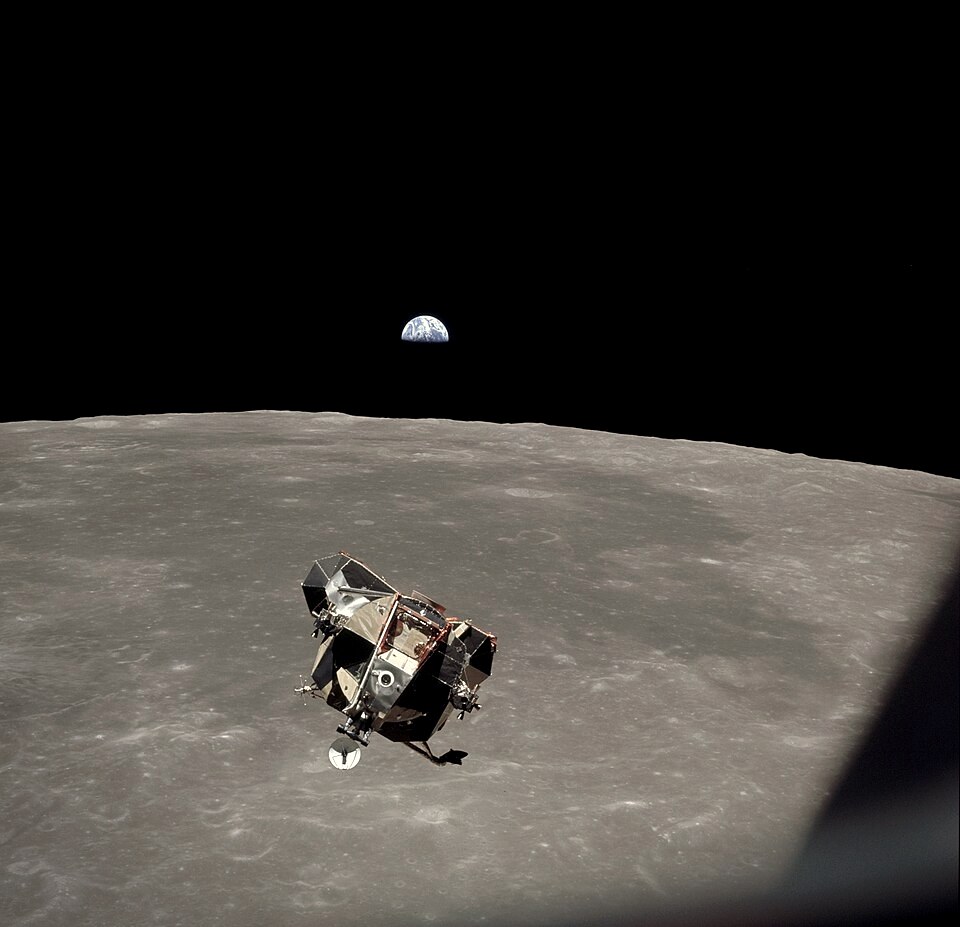
On 21 July 1969, a man named Mike took a photograph of every human being who had ever lived.
He is the only one not in it.
Michael Collins was orbiting the Moon in the command module Columbia while Armstrong and Aldrin walked on the surface. The lunar module Eagle is in the foreground of his frame, two colleagues visible inside it. Earth is behind it. Every person, alive or dead, is in that picture somewhere. Except him.
Two colleagues in shot. Still not with him.
That photograph is on the wall in my office. Not because of the engineering. Because of the position.
It is the most accurate picture of being a business owner I have ever seen. The whole of humanity in your viewfinder. Two trusted colleagues nearby, almost in reach, but doing their own job on a different surface. You are holding the camera.
The shape of it
You cannot take the problem home. You will not burden your partner with it. You will not show weakness to the team because you have decided the team should not see it.
The successes are easy to share. The 3am imposter-syndrome thoughts are not.
I have sat with business owners, brokers, clinic owners, family-office principals, and founders running businesses of every shape. The conversation always finds the same place. It usually starts with the numbers, then moves to a person, then lands somewhere quieter. A version of: "I don't know who I can say this to."
One MD told me he had not spoken about a particular cashflow worry for seven months. Not to his wife. Not to his FD. Not to his board. He had carried it on his own through two board meetings and one family holiday. When he finally said it out loud, in my office, on a Tuesday afternoon, the worry took 11 minutes to articulate and about 40 minutes to solve. The cost of the silence was seven months of bad sleep.
Solitude is not loneliness
Here is the move most leadership writing misses.
Collins himself rejected the "loneliest man" label. He said so in his book, Carrying the Fire. He felt solitude, not loneliness. The two are not the same.
Solitude is the structural condition of the job. Someone has to hold the camera. Someone has to make the call, no one else can make. That is what you signed up for when you took the title.
Loneliness is a choice you make about that condition. It is what happens when you decide that the solitude has to be carried in silence, by you, alone, indefinitely.
The first is unavoidable. The second is not.
What I tell clients to do about it
There are three moves I see that work.
One. Find one peer you do not work with. Not a coach. Not a consultant. A peer running a business of a similar shape, in a different sector, with no commercial overlap. You meet once a quarter. You both bring one thing you cannot say out loud anywhere else. The Vistage and TAB groups are formalised versions of this. A WhatsApp thread with two trusted founders is the lighter version. Either works. None at all does not.
Two. Write down your worry before you sleep on it. Pen and paper. Three lines. The thing that you are afraid of, what you would tell a friend in the same position. This is not journalling. It is a release valve. The worry shrinks the second it leaves your head. I have done this myself more times than I would care to admit.
Three. Build the question into your week, not your crisis. Most MDs only reach for help when the building is on fire. By then, the call is harder, the options are fewer, and the cost is higher. A 90-minute call once a fortnight with the right person stops the fire before it starts. Cheap to run. Hard to put on the calendar. Worth it.
The photograph as a reminder
Collins came home, retired, became director of the National Air and Space Museum, wrote one of the finest astronaut memoirs ever published, and lived to 90. The position did not break him. The job did not break him. What he never did was pretend the position was something other than what it was.
He named it. Then he got on with it.
That is the work.
If you are running a business and the photograph feels familiar this week, you are not the only one. You are just the one holding the camera.
What is the one thing that pulled you out?
Tell me in the comments, or, if it is the kind of thing you would rather not say out loud yet, send me a message.